Choosing a frontend framework in 2026 is no longer just a technical decision. It influences hiring flexibility, development costs, delivery speed, long-term maintenance, and how easily a digital product can adapt as business requirements evolve.
Despite the rise of newer frontend technologies such as Svelte, Qwik, and Astro, React, Vue, and Angular continue to dominate commercial web development because of their mature ecosystems, enterprise adoption, and long-term community support. Recent developer surveys and ecosystem data consistently show React leading in developer adoption, while Angular maintains a strong presence in enterprise software and Vue remains a preferred choice for startups and lean product teams.
However, popularity alone shouldn’t determine your decision. A startup building an MVP, a fast-growing SaaS company, and an enterprise managing multiple engineering teams have very different technical and business priorities.
Rather than asking which framework is the most popular, founders should ask a more practical question:
Which framework will reduce engineering risk, support future hiring, and scale with the business over the next three to five years?
This guide compares React vs. Vue vs. Angular across performance, hiring availability, scalability, ecosystem maturity, development experience, and long-term maintenance to help you choose the right framework for your product.
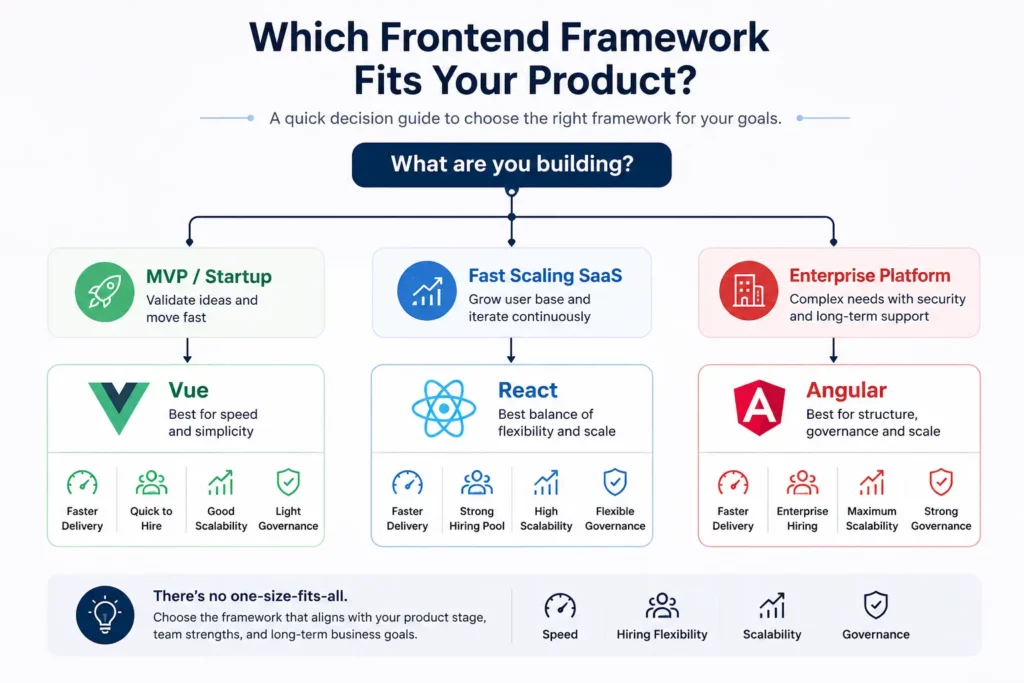
Quick Decision Guide
| Business Requirement | Recommended Framework | Why |
| Building an MVP with a small team | Vue or React | Faster development, easier onboarding, and access to mature libraries for rapid product validation. |
| Planning rapid team expansion | React | Largest developer ecosystem, easier hiring, and broad community support for long-term scaling. |
| Enterprise software development | Angular | Built-in architecture, dependency injection, and TypeScript-first development improve consistency across large teams. |
| Internal dashboards and business tools | Vue or React | Faster implementation with less architectural overhead for medium-complexity applications. |
| Multiple engineering teams | Angular or React | Better governance, reusable component strategies, and scalable development workflows. |
| Web + Mobile roadmap | React | React Native allows teams to reuse frontend expertise across web and mobile products. |
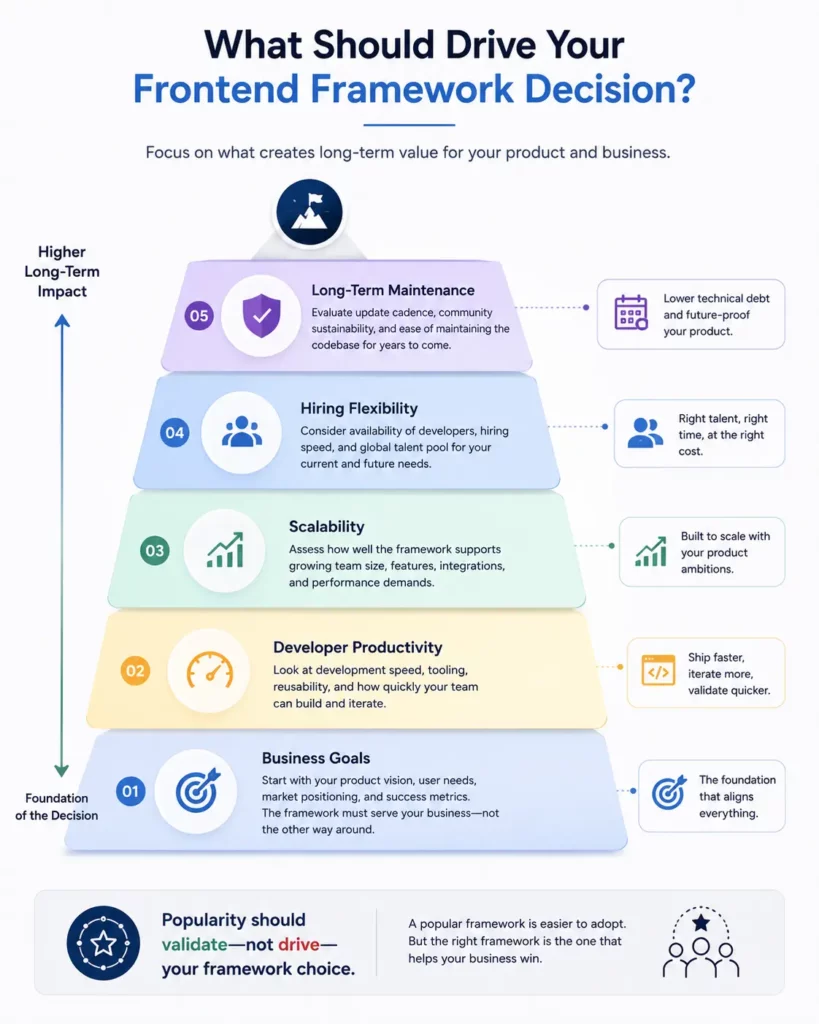
Many decision makers choose a frontend framework based on industry popularity or the technology stack used by well-known companies. In practice, successful framework selection depends far more on business priorities than market trends. A startup validating an MVP may prioritize rapid delivery and hiring flexibility, while an enterprise managing multiple engineering teams may focus on governance, maintainability, and standardized development practices.
The best framework is the one that aligns with your product roadmap, engineering capabilities, and long-term growth strategy, not necessarily the one with the largest community.
Structural decisions are expensive to reverse. Choosing a frontend technology affects hiring, onboarding, testing strategy, third-party integrations, and future maintenance long after the first version of the product is launched.
React in 2026: Why Companies Still Choose It
React remains the most widely adopted frontend library in 2026, supported by one of the largest developer communities, a mature open-source ecosystem, and thousands of actively maintained third-party libraries. Its continued popularity is reflected across recent Stack Overflow Developer Surveys, GitHub repository activity, npm ecosystem trends, and widespread commercial adoption.
Current ecosystem indicators include:
- One of the largest open-source frontend communities on GitHub.
- Millions of weekly npm package downloads across the React ecosystem.
- Strong hiring demand across startups, SaaS companies, fintech, healthcare, and established business environments.
- Extensive third-party libraries covering state management, testing, routing, UI components, and animations.
- A mature cross-platform ecosystem through React Native.
For many applications, React’s greatest advantage is reducing long-term dependency risk. When engineering teams grow or change, finding experienced React developers is generally easier than recruiting for less common frontend technologies. This flexibility becomes increasingly valuable as products mature.
Where React Creates Business Value
- SaaS platforms – React’s reusable component architecture helps SaaS teams ship new features faster while maintaining a consistent user experience across dashboards, customer portals, and subscription workflows.
- Customer-facing applications – React’s ecosystem supports complex customer-facing applications such as marketplaces, booking platforms, fintech products, and streaming services where real-time updates, reusable UI components, and extensive third-party integrations are essential.
- Web and mobile products – React Native enables existing frontend expertise to extend into mobile development, reducing the learning curve when expanding beyond web applications.
Hiring and Long-Term Cost
One of React’s strongest business advantages is its hiring ecosystem. Its broad adoption makes it easier to recruit experienced React developers as development capacity expands. This reduces hiring delays, simplifies onboarding, and lowers delivery risk during product expansion.
However, React’s flexibility also requires discipline. Because it leaves many architectural decisions to development teams, technical teams must establish clear standards for component design, state management, testing, and code reviews. Without these practices, growing teams can introduce inconsistent implementations that gradually increase maintenance costs.
Performance Improvements in 2026
React continues to improve performance without requiring developers to manually optimize every interaction.
The React Compiler automates several optimization tasks that previously required developer intervention, reducing the need for manual memoization and allowing engineering teams to spend less time on performance optimization. Improvements to rendering behavior, including automatic batching and smarter update handling, also benefit dashboards, collaborative tools, and data-intensive applications where responsiveness directly affects user experience.
While these enhancements are valuable, it’s important to remember that no tool automatically guarantees performance. Poor component design, excessive network requests, and inefficient state management can create bottlenecks regardless of the technology selected.
A Practical Observation from Real Projects
One pattern repeatedly appears during frontend modernization initiatives. Teams often spend weeks comparing React, Vue, and Angular before development begins, yet far less time defining reusable components, coding standards, or review processes. In practice, those engineering decisions have a much greater influence on long-term delivery speed than the stack itself. Well-defined frontend standards usually outperform structure selection alone when products begin to scale.
Founder Insight
Across product development engagements, we’ve observed that React is often selected not because it offers the most features, but because it provides scaling applications with greater flexibility to expand engineering teams, integrate new technologies, and extend products to mobile platforms without changing their frontend expertise.
When React May Not Be the Best Choice
React is not the right fit for every software product.
Companies that prefer strict architectural conventions, built-in solutions for common requirements, or consistent development standards from the beginning may find Angular more suitable. Smaller teams looking for a simpler learning curve and faster onboarding may benefit from Vue’s more guided development experience.
Selecting React simply because it dominates the market is rarely the best reason to adopt it. Technology decisions should align with business objectives, engineering capabilities, and future growth plans—not popularity alone.
Vue in 2026: Why Lean Teams Continue Choosing It
Vue continues to be one of the leading frontend technologies in 2026, supported by a growing open-source ecosystem, an active developer community, and increasing adoption among startups, SaaS companies, and product teams that prioritize development speed and simplicity.
While React dominates overall ecosystem size and Angular remains a preferred framework for large-scale organisations, Vue has established itself as a strong choice for teams seeking rapid development without sacrificing scalability.
Current ecosystem indicators include:
- Widely adopted for MVPs, SaaS products, internal business applications, and greenfield development projects.
- Growing npm package downloads and active community contributions.
- Mature official tooling through Vue Router, Pinia, and Vite.
- Strong integration with modern build tools and server-side rendering.
- Increasing adoption for greenfield projects where developer productivity is a priority.
Rather than competing on ecosystem size, Vue’s strength lies in developer productivity. Teams can become productive faster, making it an attractive option for development functions with limited frontend resources or aggressive delivery timelines.
Where Vue Fits Best
- Early-stage products – Startups building MVPs, customer portals, dashboards, and internal business tools often benefit from Vue’s approachable syntax and faster onboarding, allowing teams to focus more on solving business problems than learning stack conventions.
- Teams with limited frontend resources – Teams without dedicated frontend architects can begin development with less initial complexity while still building scalable applications. As projects grow, architectural standards remain important regardless of the technology chosen.
Technical Strengths
Vue 3.5 introduces further improvements to reactivity, hydration, and server-side rendering while continuing development of Vapor Mode, an optional compilation strategy designed to reduce runtime overhead by minimizing reliance on the virtual DOM. Although Vapor Mode is still evolving, it reflects Vue’s continued focus on improving runtime efficiency. Frontend architects should evaluate these enhancements based on project requirements rather than adopting them simply because they are new.
Hiring and Cost
Vue’s developer community is smaller than React’s, but many technology leaders see value in its lower learning curve and faster onboarding. For long-term functional teams, Vue’s lower learning curve can offset its smaller talent pool by reducing onboarding time and accelerating developer productivity.
Products expected to scale rapidly should also account for future hiring needs. Access to experienced developers becomes increasingly important as applications grow beyond the original development group.
Vue vs React: The Practical Difference
The choice between Vue and React is rarely about technical capability. Both structures support sophisticated web applications.
The real difference is how development teams work.
Vue reduces the number of architectural decisions developers need to make during the early stages of a project, helping smaller teams begin feature development more quickly. React provides greater flexibility but expects engineering teams to establish conventions for routing, state management, and project structure as applications become more complex.
Neither approach is universally better. The right choice depends on the delivery model, technical maturity, and long-term growth plans.
When Vue May Not Be the Best Choice
Vue may not be the strongest fit for technology-driven organizations expecting rapid global hiring, multiple specialized frontend teams, or highly standardized engineering processes across large departments. In these situations, React’s broader ecosystem or Angular’s opinionated structure can provide advantages that become more valuable as organizations scale.
Another practical consideration is ecosystem maturity. Although Vue’s ecosystem continues to grow, complex platforms-focused tooling and community resources remain more extensive within React’s ecosystem, which can simplify implementation for highly specialized requirements.
| Category | Vue | React |
| Learning Curve | Easier | Moderate |
| Initial Productivity | High | Medium |
| Ecosystem Size | Growing | Largest |
| Hiring Availability | Moderate | High |
| Architectural Flexibility | Guided | Flexible |
For smaller engineering teams, Vue often reduces development overhead during the early stages of product development. Growing teams expecting rapid expansion may benefit from React’s larger hiring ecosystem and wider range of community-supported solutions.
Founder insight
Across MVP development projects, we’ve found that founders often choose Vue when speed to market is the primary goal. For early-stage products with small engineering teams, reducing setup complexity and accelerating delivery frequently provides more business value than adopting the largest frontend ecosystem.
Angular in 2026: Why Enterprises Still Choose It
Angular remains one of the leading frontend frameworks for large-scale software development in 2026, supported by a mature ecosystem, long-term backing from Google, and widespread adoption across industries such as finance, healthcare, government, and large-scale SaaS platforms. While React emphasizes flexibility and Vue focuses on developer productivity, Angular continues to stand out through its structured architecture and built-in development capabilities.
Current ecosystem indicators include:
- Strong adoption across large-scale organisations in software and regulated industries.
- Long-term backing and continuous updates from Google.
- Built-in tooling for routing, dependency injection, forms, and testing.
- Mature TypeScript-first ecosystem for large engineering teams.
- Widely used for large-scale internal business applications.
Hiring and Long-Term Maintenance
Angular’s hiring pool is smaller than React’s but remains strong within established business platforms. For teams maintaining long-term development resources, Angular’s standardized approach can reduce onboarding complexity and improve long-term maintainability.
Where Angular Fits Best
Enterprise software — Banking, healthcare, insurance, government, and large business platforms frequently require standardized coding practices, predictable architecture, and long-term maintainability across large internal development groups.
Large development teams — Angular promotes consistency through built-in capabilities such as dependency injection, routing, form management, and its TypeScript-first approach, making collaboration easier as more developers contribute to the same codebase.
Performance Updates in 2026
Angular continues evolving its performance model through Angular Signals, which provide more efficient reactive state management and reduce unnecessary updates within complex applications.
The stack’s movement toward a zoneless architecture also gives developers greater control over rendering behavior, improving efficiency while reducing reliance on traditional change detection mechanisms.
Together, these improvements help complex platform applications remain responsive as functionality grows, reducing unnecessary rendering work while improving performance in large, data-intensive systems.
Learning Curve and Development Approach
Angular requires more initial training than React or Vue because developers must become familiar with concepts such as dependency injection, RxJS, decorators, and its opinionated project structure. Many internal business applications consider this investment worthwhile because standardized development practices improve collaboration, reduce long-term maintenance costs, and create greater consistency as engineering teams expand.
Angular’s long-term stewardship by Google also provides many large-scale organisations with additional confidence when selecting a technology for applications expected to remain in production for many years.
Enterprise Framework Decisions Are Ultimately About Governance
Large established businesses rarely struggle because they selected the wrong frontend structure.
More often, they struggle because different engineering teams solve the same problem in different ways.
At Quickway Infosystems, we’ve observed that complex platform projects become significantly easier to maintain when technical standards are established before feature development accelerates. Angular naturally supports this discipline by encouraging consistent implementation patterns from the beginning rather than relying entirely on internal conventions.
Enterprise resource planning (ERP), banking platforms, healthcare systems, insurance portals, and government applications often benefit from Angular’s structured architecture because these projects involve multiple engineering teams, long development cycles, and strict governance requirements.
That is why framework selection for complex platforms is usually less about delivering the first feature and more about managing hundreds of future releases through standardized implementation processes.
When Angular May Not Be the Best Choice
Angular may introduce unnecessary complexity for startups, MVPs, and small engineering teams that need to iterate rapidly with limited frontend resources. In these situations, Vue or React often allow faster onboarding and shorter development cycles while still supporting future scalability.
Angular at a Glance
| Factor | Angular |
| Best For | Enterprise Software |
| Learning Curve | High |
| Hiring Availability | Moderate–High |
| Architecture | Opinionated |
| Built-in Features | Extensive |
| Governance | Excellent |
Founder insight:
Across large-scale organisation modernization projects, we’ve found that large enterprises rarely regret choosing Angular because of its learning curve. More often, they benefit from the consistency it creates once multiple engineering teams begin contributing to the same application.
Performance, Hiring, and Ecosystem Comparison
Real-World Performance: Architecture Matters More Than Framework Choice
React, Vue, and Angular are all capable of powering high-performance web applications in 2026. In production environments, differences in runtime performance are usually far smaller than the impact of application architecture, rendering strategy, state management, network efficiency, and code quality.
Each structure improves performance in different ways:
- React uses the React Compiler, automatic batching, and modern rendering improvements to reduce manual optimization and improve responsiveness in interactive applications.
- Vue focuses on lightweight rendering, improved reactivity, server-side rendering, and the continued evolution of Vapor Mode to minimize runtime overhead.
- Angular emphasizes predictable enterprise performance through Angular Signals and its transition toward a zoneless architecture, providing greater control over rendering in large-scale applications.
Across frontend modernization projects, we’ve consistently found that performance bottlenecks rarely originate from the tool itself. They are more commonly caused by inconsistent component design, excessive client-side processing, unnecessary API requests, or poorly managed application state. Selecting the right stack matters, but sound software architecture and implementation discipline have a much greater influence on long-term application performance.
Hiring Availability and Long-Term Engineering Cost
Choosing a frontend technology affects much more than development speed. It influences recruitment, onboarding, engineering consistency, maintenance costs, and how easily teams can expand over time.
| Framework | Hiring Availability | Best Hiring Scenario |
| React | High | Startups, SaaS companies, and businesses planning rapid engineering expansion |
| Vue | Moderate | Stable product teams prioritizing developer productivity and faster onboarding |
| Angular | Moderate–High | Enterprise organizations with structured engineering teams and long-term platforms |
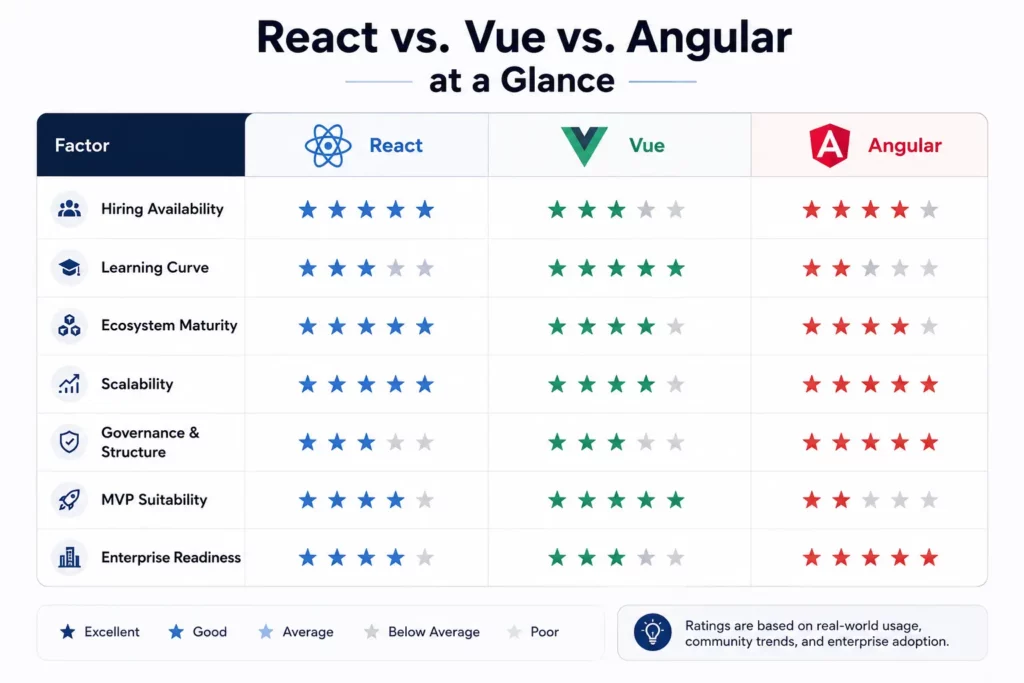
React offers the largest hiring ecosystem, making it easier for growing companies to recruit experienced developers and scale engineering capacity after product validation.
Vue has a smaller but active community. For in-house teams maintaining stable development resources, its lower learning curve can offset a smaller hiring pool by reducing onboarding time and accelerating developer productivity.
Angular remains a preferred choice within enterprise environments where enterprise leaders prioritize structured software delivery processes over maximizing candidate availability. Businesses building long-term internal platforms often value developers with experience in TypeScript, structured architectures, and established business application development.
One mistake we frequently see is planning hiring only for the initial development phase. Structural selection should also consider how easily additional developers can join the project one, three, or even five years later without increasing delivery risk or technical debt.
Ecosystem Maturity Comparison
All three technologies benefit from mature ecosystems, but they differ in focus, community size, and long-term development philosophy.
| Comparison Factor | React | Vue | Angular |
| Ecosystem Size | Largest | Growing rapidly | Mature enterprise ecosystem |
| Community Support | Extensive | Active and expanding | Strong enterprise community |
| Official Tooling | Flexible ecosystem | Vue Router, Pinia, Vite | Comprehensive built-in tooling |
| Enterprise Adoption | High | Moderate | Very High |
| Cross-Platform Support | React Native | Capacitor ecosystem | Ionic ecosystem |
| Best Fit | Diverse digital products | MVPs and SaaS | Enterprise platforms |
React provides the broadest ecosystem of third-party libraries and integrations, making it well suited to large-scale digital initiatives that may evolve over many years.
Vue emphasizes simplicity without sacrificing scalability. Its official tooling has matured considerably, allowing startups and scaling software ventures to build production-ready applications without extensive architectural setup.
Angular’s ecosystem is intentionally more opinionated. Built-in support for routing, dependency injection, forms, testing, and TypeScript reduces reliance on external libraries while improving consistency across distributed development capabilities.
Although GitHub activity, npm downloads, and community size indicate ecosystem maturity, they should not dictate technology decisions. The right stack is the one that aligns with product goals, engineering capabilities, and long-term maintenance expectations.
Should You Migrate to Another Framework?
Migrating to a new frontend tool should solve a measurable business problem rather than follow industry trends.
Consider migration when:
- Hiring has become increasingly difficult.
- Technical debt prevents efficient feature delivery.
- Legacy architecture limits scalability.
- Customer experience suffers because of technical limitations.
- Long-term maintenance costs continue increasing.
Migration may not be necessary when:
- The application remains stable and maintainable.
- Engineering teams are productive.
- Performance challenges stem from architecture rather than stack limitations.
- Business goals can be achieved through incremental modernization.
Across modernization engagements, we’ve observed that software teams often achieve better outcomes by improving architecture, upgrading dependencies, and modernizing frontend practices rather than rebuilding applications from scratch.
Will Newer Frameworks Replace React, Vue, and Angular?
Structural technology such as Svelte, Astro, Qwik, and SolidJS continue to gain attention by solving specific performance and developer experience challenges.
- Svelte reduces runtime overhead through compile-time optimization.
- Astro minimizes client-side JavaScript for content-focused websites.
- Qwik improves initial load performance through resumability.
- SolidJS offers highly efficient fine-grained reactivity.
While these technologies are technically impressive, React, Vue, and Angular continue to dominate commercial software development because of their mature ecosystems, long-term support, extensive documentation, and larger hiring markets. For most software products, reducing delivery risk and ensuring long-term maintainability remain more important than adopting the newest structure.
Common Frontend Framework Selection Mistakes
Choosing a frontend technology is rarely the hardest part of building a successful application. More often, projects become difficult to maintain because important engineering decisions are delayed until after development begins. The most successful teams evaluate frontend technologies based on long-term product goals, engineering capabilities, hiring plans, and future scalability rather than short-term trends.
Choosing Based Only on Popularity
A tool’s popularity does not automatically make it the right choice for every business. While React has the largest ecosystem, Vue may better support lean product teams, and Angular may provide greater long-term consistency for enterprise applications. Product complexity, team expertise, and business objectives should carry more weight than industry trends or community size.
Ignoring Future Hiring and Team Growth
The stack that works well for a three-person development team may become more difficult to manage as the company grows. Recruitment, onboarding, knowledge transfer, and long-term engineering consistency should be evaluated before development begins. Planning for future hiring early often prevents expensive architectural changes later in the product lifecycle.
Optimizing Only for the First Release
Many organizations select a technology based solely on how quickly they can launch an MVP. While speed to market is important, frontend decisions should also consider the product’s expected evolution over the next several years. A structure that accelerates early development may require additional governance, tooling, or architectural planning as engineering teams expand and application complexity increases.
Ignoring Existing Team Expertise
Even technically excellent tools can slow delivery if development teams have limited experience with them. Development groups often achieve better results by building on existing engineering strengths rather than introducing unnecessary learning curves that delay feature delivery, increase onboarding time, and reduce early development velocity.
Expecting the Framework to Solve Architectural Problems
React, Vue, and Angular all provide strong foundations for modern web applications, but none replaces sound software architecture and development discipline. Poor component design, inconsistent state management, limited testing, weak documentation, and unclear coding standards can create long-term maintenance challenges regardless of the technology selected. Strong architecture and development discipline remain more important than technology choice alone.
Assuming Migration Is the Only Solution
When products become difficult to maintain, organizations sometimes assume that changing technologies will solve delivery challenges. In practice, issues such as technical debt, slow releases, and declining performance often stem from architectural decisions or development processes rather than the frontend tool itself. Before considering a migration, technical stakeholders should identify whether the root cause lies in the application architecture, development workflows, or the technology stack.
Founder Insight
Across frontend modernization and product development projects, we’ve observed that successful stack decisions rarely depend on choosing the “most popular” technology. Teams that invest in clear engineering standards, realistic hiring plans, and long-term architectural thinking typically build applications that are easier to maintain, scale, and evolve as business requirements change.
A Five-Question Decision Framework
Before choosing React, Vue, or Angular, answer these five questions:
- What type of product are you building?
- How large will the development team become?
- Will the product require rapid scaling?
- How important is hiring flexibility?
- Which trade-offs matter most?
Decision Takeaway
The most successful framework decisions begin with business priorities rather than technology trends. Instead of asking “Which frontend framework wins in 2026?”, ask “Which structure best supports our product, engineering team, and long-term growth strategy?” That shift in perspective leads to technology decisions that remain effective long after the initial product launch.
Final Recommendation
There is no universally “best” frontend framework, only the framework that best supports your product strategy, engineering capabilities, and long-term business goals.
React is an excellent choice for technology-driven enterprises that prioritize hiring flexibility, ecosystem maturity, cross-platform development, and the ability to scale products through a large developer community.
Vue is well suited to startups, MVPs, and lean product teams that value rapid development, faster onboarding, and a simpler development experience without sacrificing long-term scalability.
Angular remains one of the strongest options for enterprise software where governance, standardized engineering practices, security, and long-term maintainability are more important than rapid prototyping.
Across frontend product development projects, one lesson consistently stands out: successful applications are rarely defined by the framework alone. They succeed because technology decisions are supported by strong architecture, disciplined engineering practices, and realistic planning for future growth.
At Quickway Infosystems, framework selection begins with understanding the business—not the technology. Before recommending React, Vue, or Angular, our engineering team evaluates product objectives, expected team growth, hiring strategy, integration requirements, scalability expectations, and long-term maintenance effort. This approach helps organizations choose technologies that continue delivering value long after the initial product launch.
The best frontend framework is the one your team can confidently build, maintain, and evolve as your business grows.
Final Decision Matrix
| If your priority is… | Recommended Framework | Why |
| Build an MVP quickly | Vue | Faster onboarding and lower development complexity |
| Access the largest developer ecosystem | React | Broad community support and easier hiring |
| Scale engineering teams rapidly | React | Large talent pool and flexible architecture |
| Build enterprise business applications | Angular | Strong governance and standardized development practices |
| Maintain long-term internal platforms | Angular | Built-in tooling and predictable architecture |
| Enable rapid product iteration with a small team | Vue | High developer productivity and approachable learning curve |
| Build web and mobile applications | React | Strong ecosystem with React Native support |
Key Takeaways
- Choose React when hiring flexibility, ecosystem maturity, and long-term product evolution are top priorities.
- Choose Vue when rapid development, developer productivity, and simplicity matter most for startups or lean product teams.
- Choose Angular when building enterprise applications that require governance, consistency, and long-term maintainability.
- Evaluate frontend frameworks based on business goals, engineering capabilities, and expected product growth, not popularity alone.
- Strong software architecture, engineering standards, and development practices have a greater long-term impact than the frontend framework itself.
- Migrate to a new framework only when there is clear business value, not simply because newer technologies have emerged.
Frequently Asked Questions
How do you choose the right frontend framework for a new product?
The right frontend framework depends on your product goals, expected team growth, hiring strategy, integration requirements, and long-term maintenance plans rather than popularity alone. At Quickway Infosystems, framework selection begins with understanding the business objective before evaluating the technical options. This approach helps founders and product teams choose a technology that continues supporting the product as it scales instead of optimizing only for the first release.
Should startups prioritize faster development or a larger developer ecosystem?
There is no universal answer because it depends on the company’s growth strategy. Startups focused on rapid product validation often benefit from simpler development workflows, while high-growth software initiatives expecting aggressive hiring or multiple product expansions may gain more value from a larger ecosystem. During product discovery, our engineering teams typically evaluate both immediate delivery speed and long-term scalability before recommending a frontend technology.
What factors matter most when comparing React, Vue, and Angular for long-term scalability?
Long-term scalability depends on more than frontend performance. Businesses should evaluate hiring availability, engineering governance, architecture flexibility, integration complexity, maintenance effort, and expected product evolution. At Quickway Infosystems, these business and engineering factors are reviewed together so the selected framework remains suitable as development teams and product requirements grow.
Is it worth rebuilding an existing application in a different frontend framework?
Not always. A migration should solve measurable business challenges such as rising maintenance costs, hiring difficulties, slow feature delivery, or architectural limitations. In many modernization projects, organizations achieve better outcomes by improving the existing architecture instead of rebuilding the entire frontend. A technical assessment should identify the root cause before deciding whether migration is necessary.
How does frontend framework selection affect development costs over time?
Initial development cost is only one part of the equation. Recruitment, onboarding, developer productivity, maintenance, technical debt, and future feature development usually have a greater financial impact over the product lifecycle. Quickway Infosystems evaluates these long-term considerations alongside technical requirements to help software leaders choose frameworks that remain cost-effective as products mature.
Can React vs. Vue vs. Angular all support enterprise-scale applications?
Yes. All three frameworks are capable of supporting large-scale applications when implemented using sound engineering practices. The difference lies in how they approach architecture, governance, and developer workflows. The most successful enterprise projects typically combine the right framework with clear coding standards, testing strategies, and long-term maintenance planning rather than relying on the framework alone.
What questions should founders ask before selecting a frontend framework?
Before making a decision, founders should consider:
- What type of product are we building?
- How quickly will the engineering team grow?
- What integrations will the application require?
- How important is hiring flexibility?
- What level of long-term maintenance should we expect?
These questions form the foundation of the framework evaluation process followed by Quickway Infosystems, ensuring technology decisions align with business objectives instead of short-term trends.
Can the wrong frontend framework slow business growth?
Yes, but usually not for the reasons people expect. Most delays come from hiring challenges, inconsistent architecture, poor engineering practices, or technology decisions that no longer match the product’s evolution. Across numerous frontend development engagements, we’ve found that selecting a framework aligned with both the product roadmap and team capabilities reduces long-term delivery risk far more effectively than simply choosing the most popular technology.