Contact Us
HWH Studio Dubai Problem Statement

Client Snapshot

Boom & Mellow is a Dubai-based boutique offering jewelry, accessories, and gifting products. It sells through its Shopify store and two physical locations: Town Centre Jumeirah and The Springs Souk. Its online presence serves customers researching products, exploring gifting ideas, and looking for the brand's physical stores across Dubai.

HWH Studio Dubai Project Overview

The Challenge

The objective was not simply to improve rankings. Boom & Mellow needed to connect the full organic journey. That meant linking search queries to editorial content, collection pages, product discovery, and AI search, all the way to measurable ecommerce activity.

  • Important collection pages needed stronger internal authority.
  • Blog content was generating impressions but had room to capture more qualified clicks.
  • Informational content was not consistently connected to relevant commercial and product pages.
  • Technical, local, and AI-search opportunities needed to be addressed alongside traditional SEO.
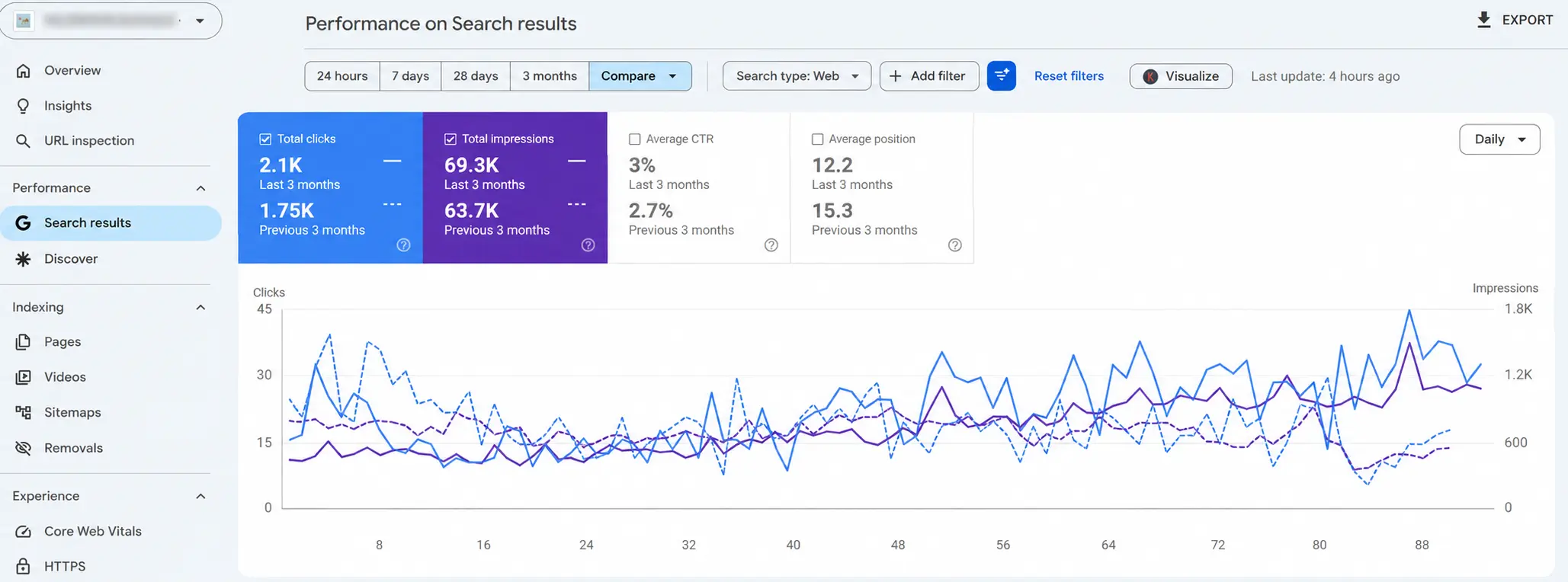
Boom and Mellow Dubai 3 months SEO organic performance
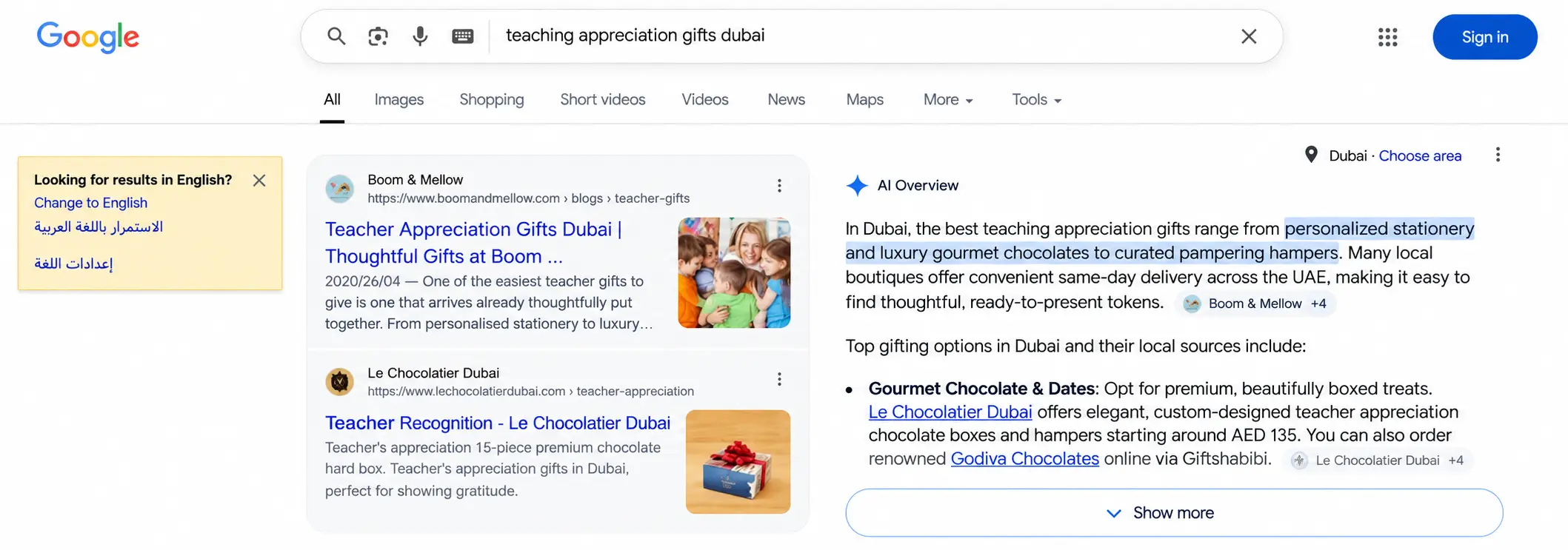
Boom and Mellow AI organic visibility
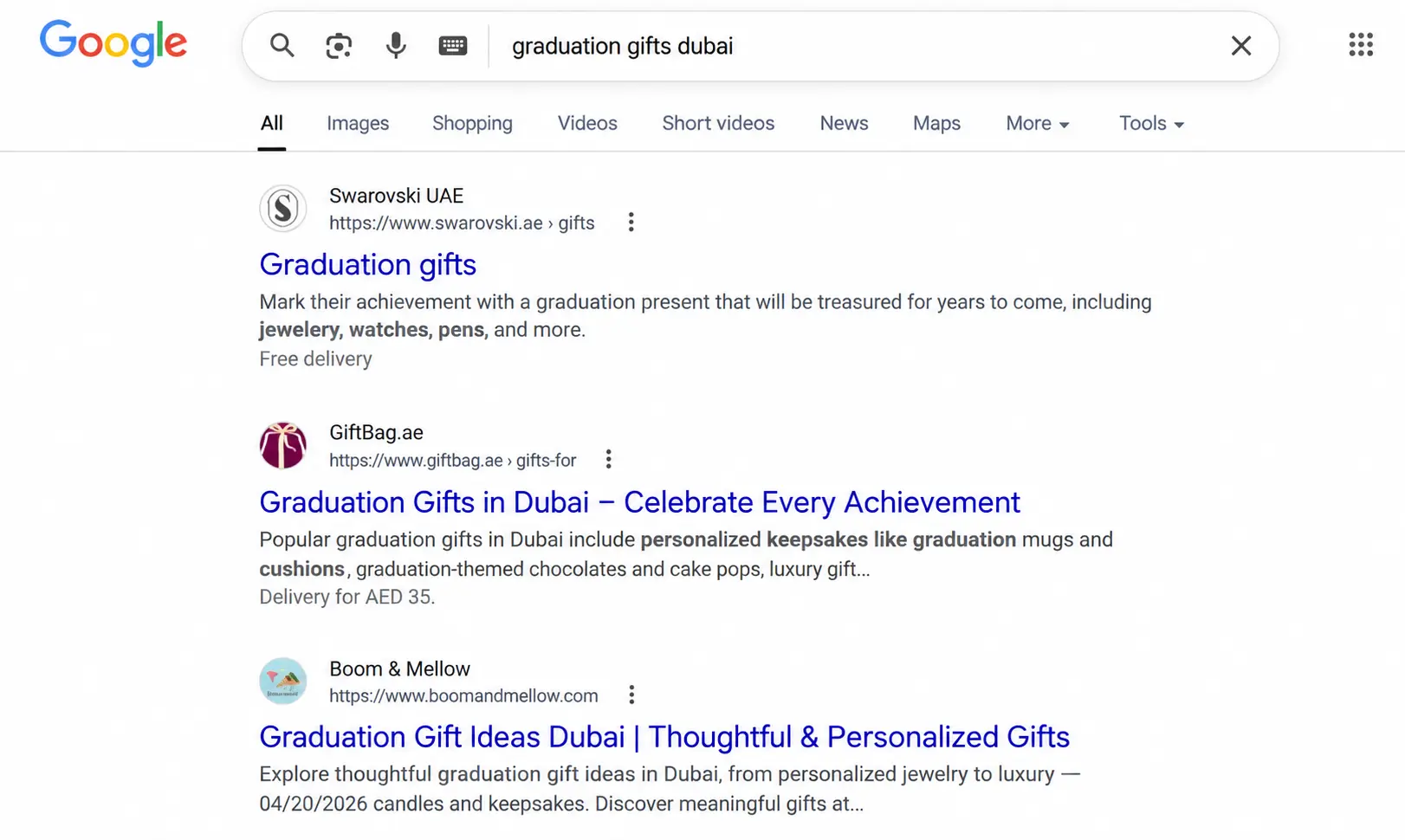
Boom and Mellow organic rankings
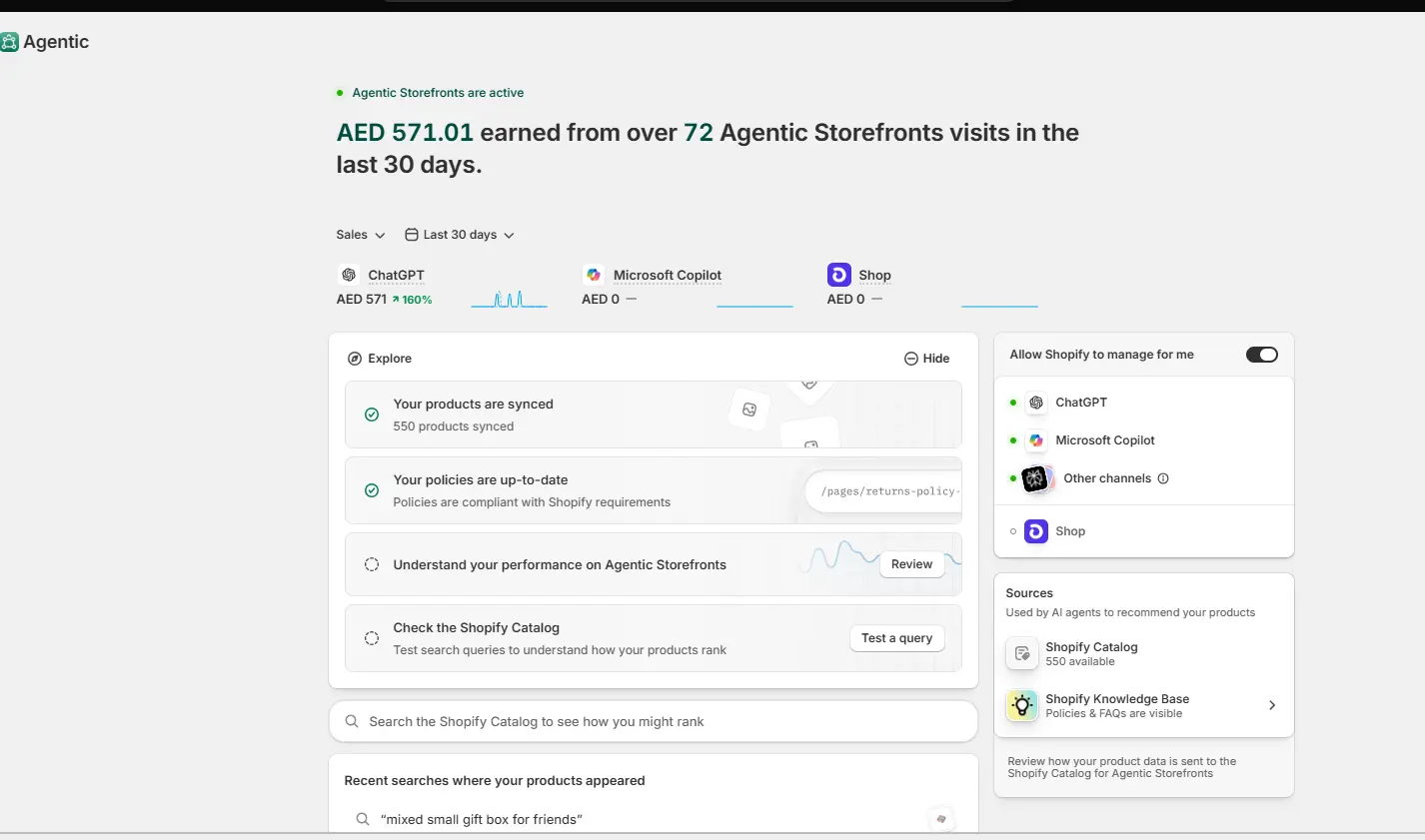
Boom and Mellow storefront AI revenue

The Strategy

A structured SEO approach connecting content, commercial pages, technical foundations, and emerging search experiences.

01

Content-to-Commerce Internal Linking

Connected Blog → Collection → Product and Product → Collection pathways so informational content could support commercial discovery.

02

Collection-Page Optimisation

Used GSC data to identify priority collection pages and improve metadata and on-page elements through approved optimisation batches.

03

Technical & Structured-Data Improvements

Addressed schema, product URL structures, redirects, and other technical elements affecting how the ecommerce site could be understood and crawled.

04

Local + AI Search Visibility

Optimised both Google Business Profiles while extending the strategy toward emerging AI-powered product discovery and search experiences.

See What AI powered discovery Could do for your store

Discuss Your Ecommerce SEO Challenge

No obligation – we’ll show you what’s realistic for your store in 30 minutes.

What We Changed

The work focused on connecting individual SEO improvements rather than treating content, technical SEO, local search, and ecommerce pages as separate activities. Each change supported a stage of the broader path from search query to product discovery.

Search Intent Mapping and SEO Strategy
01

Content-to-Commerce Connections

  • Implemented contextual Blog → Collection → Product internal links.
  • Added Product → Collection links to strengthen relationships between commercial pages.
  • Incorporated relevant products within blog content to create clearer paths from information to product discovery.
  • Used GSC data to identify pages and search opportunities requiring further optimisation.
  • Published five blog posts and submitted them for indexing.
Website Content Optimisation
02

Collection-Page Optimisation

  • Optimised priority collection-page metadata and on-page elements.
  • Proposed and implemented meta tags in batches following client approval.
  • Connected editorial content with relevant commercial collections to distribute contextual authority.
  • Prioritised optimisation based on actual GSC performance rather than applying identical changes across every page.
Expanded Search Visibility
03

Technical SEO & Structured Data

  • Audited blog schema and validated schema after implementation.
  • Audited product URL structures and validated 301 redirects following URL changes.
  • Fixed LocalBusiness schema appearing on non-location blog pages by restricting it to relevant location pages.
  • Retained Organization and WebSite schema sitewide.
  • Reviewed technical issues alongside content and page-level optimisation rather than treating them as isolated fixes.
Search-to-Booking Measurement
04

Local & Emerging Search

  • Audited and optimised both Google Business Profiles.
  • Established an ongoing Google Business Profile content workflow.
  • Created and submitted Pinterest content to support additional product discovery.
  • Extended optimisation efforts toward AI-powered search and emerging AI commerce experiences.

What This Means for the Business

Boom & Mellow's organic strategy became connected across multiple stages of customer discovery rather than relying on individual rankings or isolated content performance.

Customer Discovery

A customer can begin with a search query, find an editorial article, move through a contextual internal link to a collection, discover relevant products, encounter the brand through an AI search experience, and ultimately generate measurable ecommerce activity.

SEO Measurement

That connection gives Boom & Mellow a broader presence across the buying journey. Informational content now has a commercial role. Collection pages have stronger contextual relationships, and AI-powered product discovery has become another measurable revenue route.

Search Query → Editorial Content → Collection Page → Product Discovery → AI Search → Revenue

The case also shows why SEO measurement needs to extend beyond rankings. Search visibility establishes discovery, content and internal linking create pathways, product pages support consideration, and ecommerce analytics provide the commercial context.

“

Client Testimonial

“What stood out for us was how Quickway Infosystems connected different parts of our online store instead of treating them separately. We saw stronger visibility across our content and product collections, while their focus on AI-powered discovery also opened up a new way for customers to find our products. The approach gave us a clearer path from search visibility to actual product discovery.”

Melissa Monte, Marketing & E-commerce, Boom & Mellow

Results & Achievements

The three-month comparison shows improvement across clicks, impressions, CTR, and average position. Organic clicks increased by 20%, while average position improved by 3.1 positions, moving from 15.3 to 12.2.

Organic Search Growth: 3-Month Comparison

Clicks
1.75K → 2.1K
Previous 3 Months → Last 3 Months
+20%
Impressions
63.7K → 69.3K
Previous 3 Months → Last 3 Months
+8.8%
CTR
2.7% → 3.0%
Previous 3 Months → Last 3 Months
+0.3 pp
Avg. Position
15.3 → 12.2
Previous 3 Months → Last 3 Months
Improved by 3.1

The growth also extended beyond branded searches. Comparing May and June 2026 shows increases in both overall and non-branded impressions and clicks.

Non-Branded Search Growth: May vs June 2026

Impressions
29.4K → 35.7K
May 2026 → June 2026
Non-branded impressions
28.8K → 35.1K
May 2026 → June 2026
Clicks
857 → 1.04K
May 2026 → June 2026
Non-branded clicks
594 → 722
May 2026 → June 2026

Blog Performance: February to June 2026

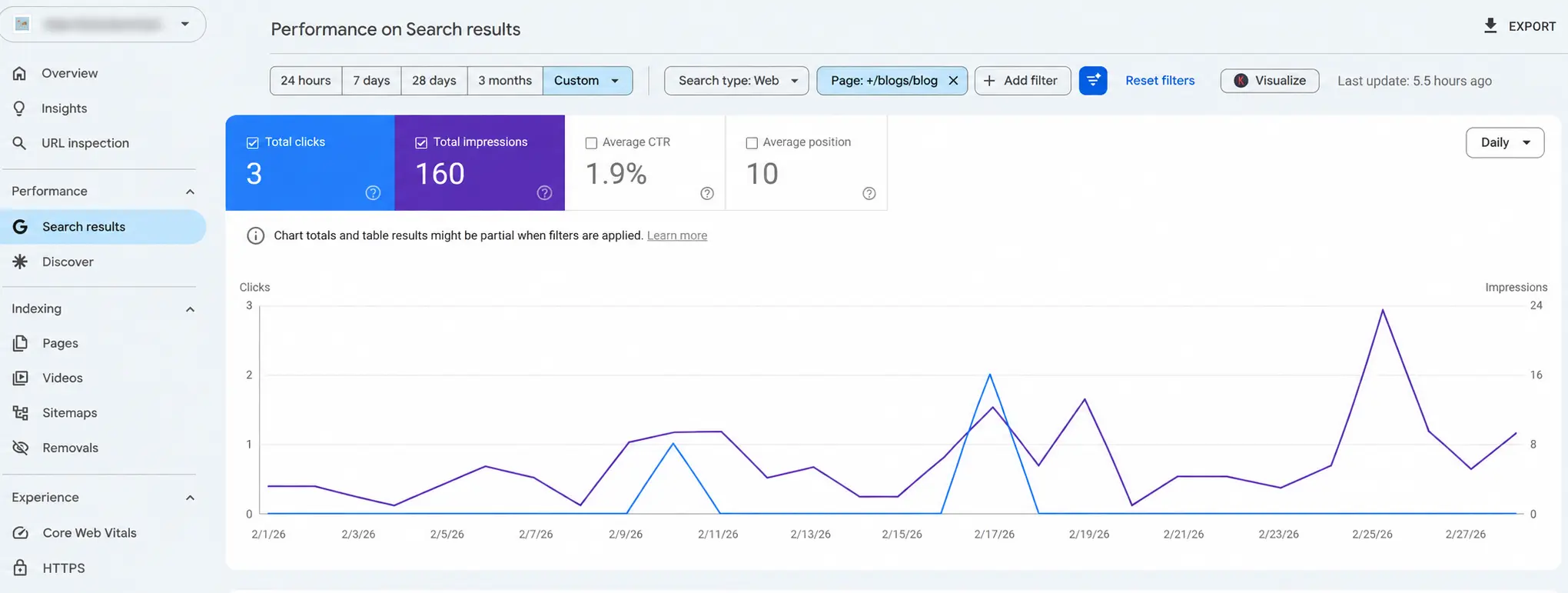
The blog became a stronger source of organic discovery during the period. Clicks increased from 3 to 92, while impressions grew from 160 to 6.94K and average position improved from 10 to 7.8.

Clicks
3 → 92
February → June
Impressions
160 → 6.94K
February → June
CTR
1.9% → 1.3%
February → June
Avg. Position
10 → 7.8
February → June

The CTR declined as visibility expanded, making the increase in impressions and clicks the more meaningful indicator of blog growth during this period.

Blog Performance: Before & After

The February-to-June comparison shows how the blog's search visibility developed over the engagement, with measurable changes in clicks, impressions, CTR, and average position.

Before — February 2026

Baseline blog performance at the start of the comparison period.

Google Search Console blog performance February 2026
Total Clicks 3
Total Impressions 160
Average CTR 1.9%
Average Position 10

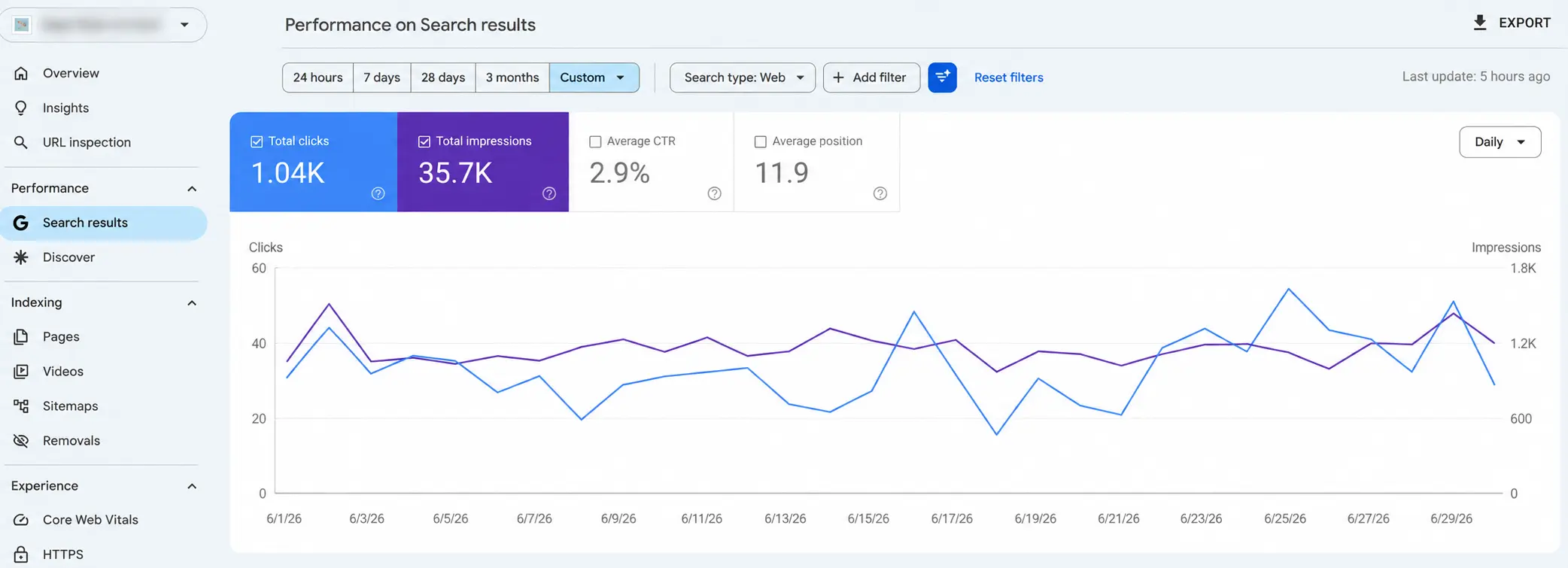
After — June 2026

Search performance recorded at the end of the comparison period.

Google Search Console blog performance June 2026
Total Clicks 1.04K
Total Impressions 35.7K
Average CTR 2.9%
Average Position 11.9

What changed: The Search Console snapshots show the change in blog search performance across the engagement period. Clicks increased from 3 to 92, while impressions grew from 160 to 6.94K, with average position improving from 10 to 7.8.
These figures provide a direct before-and-after view of the organic visibility generated during the engagement, showing that the growth reported in the case study is supported by actual Search Console performance data, not rankings alone.

Proof Points

The engagement produced measurable examples across commercial discovery, organic search visibility, and AI-powered ecommerce activity.

01

Proof Point #1: Cofin Paris

The Cofin Paris collection page shows how editorial content was used to support commercial product discovery rather than functioning as an isolated traffic asset.

Quickway Infosystems strategically linked the collection page from the article “The Evil Eye: More Than a Symbol of Protection.” The article created a contextual route from an informational search around the meaning and symbolism of the evil eye toward a relevant product collection.

The supporting content also gained visibility in Google's AI Overview for “evil eye gift meaning.” This created an additional discovery channel for the editorial asset while strengthening the connection between informational intent and the Cofin Paris collection.

The model was simple: search query → editorial content → contextual internal link → collection page → product discovery.
02

Proof Point #2: Jewelry Gifting

The article “How to Choose the Perfect Jewelry Gift” demonstrates how content can capture customers earlier in the buying journey.

The page moved from position #9 to position #2 for its target query, bringing Boom & Mellow into the top two organic results for that search.

The same content was also referenced by ChatGPT when answering a Dubai-related jewelry-gifting query. That gave the article visibility across two distinct discovery environments: traditional organic search and AI-assisted research.

The result matters because jewelry buyers often begin with a question or gifting need rather than a specific product. By appearing at the research stage, Boom & Mellow's content could introduce the brand before the customer reaches a product comparison or purchase decision.

03

Proof Point #3: AI Commerce Revenue

The most direct commercial proof came from AI-powered product discovery.

Boom & Mellow recorded AED 571.01 in revenue attributed to AI-powered storefront traffic in its Shopify analytics. During the same period, the store recorded 72 Agentic Storefront visits in the last 30 days, with 550 products synced with Agentic Storefronts.

This moves the AI-search conversation beyond visibility alone. The evidence shows a measurable path from an emerging AI commerce channel to attributable ecommerce revenue.

AED 571.01 AI-Commerce Revenue
72 Agentic Storefront visits in the last 30 days
550 products synced with Agentic Storefronts
AED 571.01 AI-Commerce Revenue

The mechanism is important: products were made available through an AI-powered storefront environment, creating another route through which customers could discover and purchase from Boom & Mellow.


Conclusion

The Boom & Mellow engagement shows that ecommerce SEO delivers greater value when content, collections, technical optimisation, and emerging search channels work as one connected strategy. Over the engagement, this approach contributed to a 20% increase in organic clicks, stronger non-branded visibility, improved rankings, and measurable AI-commerce revenue.

The key lesson is that SEO should not stop at rankings. By connecting search discovery with content, product collections, and measurable ecommerce activity, brands can build a clearer path from search visibility to product discovery and revenue.

Boom & Mellow ecommerce SEO case study

From Search Visibility to Product Discovery

For ecommerce brands, organic growth is no longer limited to ranking product pages. The opportunity extends across editorial content, collection architecture, technical signals, local discovery, AI search, and the routes that connect customers from one stage to the next.

Filling Utility